
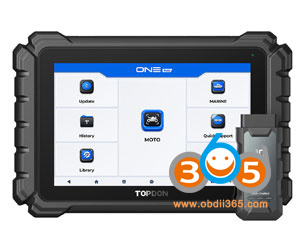
What is the difference among Topdon ONE Moto, Topscan Moto, Artidiag Moto and Ultradiag Moto Motorcycle diagnostic scanners?
Here comes the table comparison:
| Product | Topscan Moto | ArtiDiag Moto | UltraDiag Moto | Topdon ONE Moto | |
| Image |  |
 |
 |
 |
|
| Hardware Configuration | Central Processing Unit (CPU) | – | 4-Core 1.8GHz | 4-Core 1.8GHz | 8-Core2.0GHz(MT8786) |
| Memory (RAM) | – | 2G | 2G | 4G | |
| Storage (ROM) | – | 32G | 32G | 128G | |
| Battery Capacity | – | 3350mAh / 3.7V | 10000mAh / 3.7V | 10000mAh/3.8V | |
| Android Version | Android/IOS | Android 11.0 | Android 11.0 | Android 12.0 | |
| Screen Size | – | 5 inches | 8 inches | 10.1 inch | |
| Screen Resolution | – | 1280×720 | 1280×800 | 1280×800 | |
| Wi-Fi | – | 2.4 & 5 GHz | 2.4 & 5 GHz | 2.4 & 5 GHz | |
| Camera | – | – | Rear 5.0 MP | Rear 16.0 MP | |
| Weight | 78 g (2.75 oz) | 600 g (21.164 oz) | 1031 g (36.37 oz) | 6430g | |
| Communication | Bluetooth 5.0 (Distance: 33 feet/10 m) |
Main Cable | VCI/Bluetooth | ONE VCI Bluetooth/WiFi | |
| Configured Diagnostic Link Connectors (DLC) | optional | 18 | 29 | 36 | |
| Bi-Directional Control (Active Test) |
√ | √ | √ | √ | |
| OBD Diagnostics | √ | √ | √ | √ | |
| Vehicle Voltage Monitoring | × | √ | √ | √ | |
| Special Functions | One: Oil Reset | 35+ | 40+ (divided into 17 categories) |
40+ (divided into 17 categories) |
|
| Expanded functionality | IMMO | × | × | × | √ |
| Programming (usually offline or cloned) |
× | × | × | √ | |
| E-Moto (Electric Motorcycle) | × | × | × | × | |
| Support Brands | Number of Supported Vehicle Makes | 7 Vehicle Makes: Harley-Davidson / BMW / DUCATI / SUZUKI / HONDA / YAMAHA / KAWASAKI | 15 Vehicle Makes: DUCATI / BMW / PIAGGIO / KTM / BENELLI / TRIUMPH / HARLEY / BRP / INDIAN / SUZUKI / VICTORY / POLARIS / HONDA / YAMAHA / KAWASAKI | 81 Vehicle Makes | 105 Vehicle Makes |
| Accessibility | DLC Location | √ | √ | √ | √ |
| DLC Query | √ | √ | √ | √ | |
| Technical Service Bulletin (TSB) | √ | √ | √ | √ | |
| Repair Information | × | × | × | × | |
| Remote Desktop | × | √ | √ | √ | |
| language | Supported Languages for Software |
Chinese; English; Traditional Chinese; Japanese; Russian; German; Spanish; Portuguese; French; Italian; Polish; Korean; Dutch; Turkish |
Chinese; English; Traditional Chinese; Japanese; Russian; German; Spanish; Portuguese; French; Italian; Polish; Korean; Dutch; Turkish |
Chinese; English; Traditional Chinese; Japanese; Russian; German; Spanish; Portuguese; French; Italian; Polish; Korean; Dutch; Turkish |
Chinese; English; Traditional Chinese; Japanese; Russian; German; Spanish; Portuguese; French; Italian; Polish; Korean; Dutch; Turkish |
| Supported Languages for APK |
45Languages Chinese; English; Traditional Chinese; Japanese; Russian; German; Spanish; Portuguese; French; Italian; Korean; Czech; Slovak; Turkish; Polish; Arabic; Irish; Estonian; Bulgarian; Danish; Persian; Vietnamese; Indonesian; Hindi; Hungarian; Greek; Ukrainian; Thai; Sinhala; Serbian; Swedish; Slovenian; Pashto; Norwegian; Mongolian; Malay; Maltese; Romanian; Lithuanian; Latvian; Croatian; Lao; Dutch; Finnish; Filipino |
45Languages Chinese; English; Traditional Chinese; Japanese; Russian; German; Spanish; Portuguese; French; Italian; Korean; Czech; Slovak; Turkish; Polish; Arabic; Irish; Estonian; Bulgarian; Danish; Persian; Vietnamese; Indonesian; Hindi; Hungarian; Greek; Ukrainian; Thai; Sinhala; Serbian; Swedish; Slovenian; Pashto; Norwegian; Mongolian; Malay; Maltese; Romanian; Lithuanian; Latvian; Croatian; Lao; Dutch; Finnish; Filipino |
45Languages Chinese; English; Traditional Chinese; Japanese; Russian; German; Spanish; Portuguese; French; Italian; Korean; Czech; Slovak; Turkish; Polish; Arabic; Irish; Estonian; Bulgarian; Danish; Persian; Vietnamese; Indonesian; Hindi; Hungarian; Greek; Ukrainian; Thai; Sinhala; Serbian; Swedish; Slovenian; Pashto; Norwegian; Mongolian; Malay; Maltese; Romanian; Lithuanian; Latvian; Croatian; Lao; Dutch; Finnish; Filipino |
45Languages Chinese; English; Traditional Chinese; Japanese; Russian; German; Spanish; Portuguese; French; Italian; Korean; Czech; Slovak; Turkish; Polish; Arabic; Irish; Estonian; Bulgarian; Danish; Persian; Vietnamese; Indonesian; Hindi; Hungarian; Greek; Ukrainian; Thai; Sinhala; Serbian; Swedish; Slovenian; Pashto; Norwegian; Mongolian; Malay; Maltese; Romanian; Lithuanian; Latvian; Croatian; Lao; Dutch; Finnish; Filipino |
|
| Warranty | Sync with the software subscription period. | 1 Years | 1 Years | 1 Years | |
Summary:
-
The four devices form a clear tiered lineup, with Topscan Moto as the entry-level Bluetooth dongle, ArtiDiag Moto as the basic handheld, UltraDiag Moto as the mid-range tablet, and ONE Moto as the flagship workshop tool.
-
Brand coverage is the biggest differentiator, jumping dramatically from only 7 supported makes on Topscan, to 15 on ArtiDiag, to 81 on UltraDiag, and finally to 105 on ONE Moto, meaning workshops handling rare or older models must choose one of the top two models.
-
Hardware specifications scale proportionally across the range, with screen sizes growing from 5 inches to 10.1 inches, battery capacity increasing from 3350mAh to 10000mAh, and RAM and storage peaking at 4GB and 128GB on the ONE Moto, directly supporting longer work sessions and smoother multitasking.
-
IMMO and offline programming capabilities are exclusive to the ONE Moto, making it the only choice for locksmiths, used-car dealers, or workshops that need to perform deep ECU work such as immobilizer handling and cloned programming.
-
Connectivity methods vary across the lineup, with Topscan using only Bluetooth, ArtiDiag relying on a wired main cable, UltraDiag offering VCI or Bluetooth flexibility, and ONE Moto utilizing a proprietary ONE VCI for faster and more stable data transfer during heavy tasks like programming.
-
Special functions are not a major differentiator among the top three models, as UltraDiag and ONE Moto offer 40 or more functions, while Topscan is notably limited to only oil reset functionality.
-
Remote desktop assistance is available on all models except Topscan, which means less experienced users of the entry-level device cannot receive real-time remote support from technicians.
-
None of the four devices support electric motorcycles, which represents a significant gap in the product lineup given the growing two-wheeler EV market.
- In summary, the choice depends entirely on the user’s needs: Topscan for portability and basic checks, ArtiDiag for small workshops with limited brand requirements, UltraDiag for busy shops handling many brands with a large screen, and ONE Moto for professionals requiring advanced programming and IMMO capabilities.