
Does the Godiag GD101 J2534 adapter work with Mitsubishi’s MUT-3 diagnostic software?
Here comes a real user report:
Why Consider Replacing the Outdated Adapter?
Despite its popularity, the old Toyota Mini VCI diagnostic adapter has several significant drawbacks compared to modern options. Even on a limited budget, you can get a more stable and functional alternative that offers better compatibility with modern diagnostic equipment.
- Honestly execute J2534 API commands without emulation;
- Function as a universal ELM327 adapter, significantly expanding its capabilities;
- Provide more stable operation with various diagnostic software programs.
At the heart of the adapter lies the Nation N32G435 microcontroller, developed by the Singapore-based company Nsing.com.sg; it serves as an equivalent to the more expensive STM32G431. Its specifications are impressive:
32-bit Arm® Cortex®-M4F core with a maximum operating frequency of 108 MHz (135 DMIPS), supporting floating-point operations and DSP instructions. It integrates 128 KB of embedded encrypted Flash memory and 32 KB of SRAM. A built-in 2 KB instruction cache supports a Flash acceleration unit for zero-wait program execution. The series features a rich set of high-performance analog components, including one 12-bit 5 Msps ADC, two independent rail-to-rail operational amplifiers, two high-speed comparators, and one 12-bit 1 Msps DAC.
Regarding digital communication interfaces, it integrates multiple U(S)ART, I2C, SPI, USB 2.0 FS (12 Mbit/s), and CAN 2.0A/B interfaces. It also incorporates various hardware acceleration engines for cryptographic algorithms.
The board includes an SIT1050 CAN transceiver, enabling diagnostic speeds of up to 1 MBaud via the CAN 2.0B protocol.
The LM293 chip—comprising two independent low-voltage comparators designed for operation from a single power supply across a wide voltage range—is used to handle legacy SAE-J1850 protocols:
J1850 PWM, supporting IFR (In-Frame Response) and a double-speed mode of 83.2 kbps.
J1850 VPW, supporting a quadruple-speed mode of 41.6 kbps.
The K-Line interface is implemented using transistors.
Located at the top is U1, an AMS1117-3.3 voltage regulator providing 3.3 V.
An 8 MHz T080 crystal oscillator sets the clock frequency for the microcontroller and the USB bus. Contacts J1 and J2 are intended for microcontroller programming and diagnostics.
MS-CAN and HS-CAN support
Although the adapter officially supports only K-Line, SAE-J1850, and CAN, it can easily be converted into an MS-CAN/HS-CAN adapter by desoldering resistors R59 and R60 and installing a switch at J16.
The adapter is capable of shorting pin 9 to ground (pin 5) on the OBD2 connector, a requirement for initializing diagnostic sessions on certain ECUs and firmware versions from Japanese manufacturers.
The adapter supports an operating voltage range of 8–18V and can supply up to 20V to pins 12 and 13 of the OBD2 connector; this is necessary to enable programming modes on specific ECUs and firmware in Toyota, Mitsubishi, and Honda vehicles.
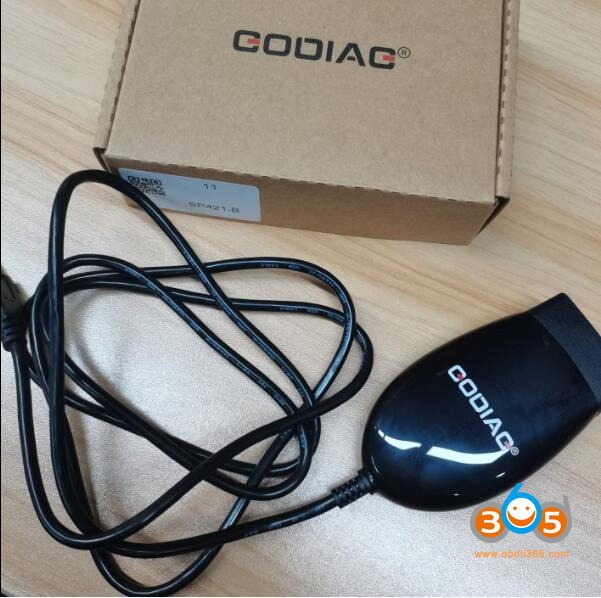
The adapter is marketed as a replacement for the aging Openport 2.0, which had previously replaced the Mini-VCI J2534.
The package does not include the now-obsolete DVD containing drivers and software. You need to download software by yourself.
Step-by-step setup guide for Godiag J2534 with MUT-III software;
If you intend to use the Godiag GD101 or VNCI Nano as an ELM327 v1.3a adapter, simply plugging it into a laptop’s USB port is sufficient; a virtual COM port with the ID `VID_E327&PID_2534` will appear in Windows even without connecting the device to a vehicle’s OBD2 port. This COM port allows you to use software such as ForScan, ScanMaster, etc. The driver is required only for PassThru support.