
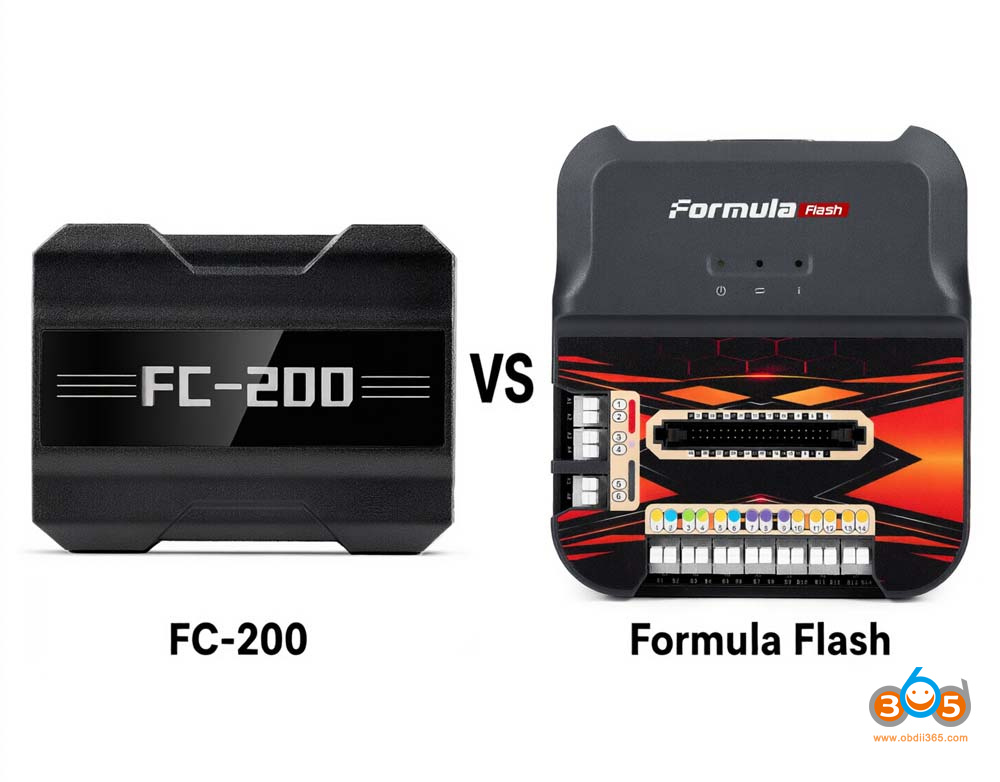
CG FC200 and FormulaFlash which to buy for beginners? What’s the difference between these tools?
Key Comparison
|
Aspect
|
||
|---|---|---|
|
Manufacturer / Maturity
|
Established CGDI product (successor/related to AT200); mature with ongoing updates
|
Newer independent tool (roughly 1–2+ years old as of recent reviews); actively developing with frequent protocol additions
|
|
Primary Focus
|
ECU/EGS (ECU + transmission) cloning, data processing, BMW ISN read/write, VIN modification
|
All-in-one ECU/TCU tuning: read/write + strong built-in “Data Center” for one-click modifications
|
|
Operating Modes
|
OBD (CAN-bus), Bench (platform), Boot
|
Bench and Boot well-supported; OBD available for specific models and expanding
|
|
ECU Coverage
|
Claims ~4,200 ECUs/EGS covering ~80% of market models. Strong on Bosch (EDC/MED/ME series, MD1/MG1), BMW (excellent ISN via OBD for many MSV/MSD/N/B-series), VAG, some Continental/Delco/Denso/Delphi (licenses often included in full version), Chinese vehicles, various TCUs (e.g., ZF 8HP/9HP, GETRAG)
|
~4,000+ common models. Strong on Bosch, Siemens, Delco, Marelli, Chinese vehicles; expanding into more Delco, Continental (e.g., SID series), Toyota Denso Gen3, etc. Some unique early support (e.g., certain ZF AL552 bench, specific Delco IMMO). Coverage lists differ—FC200 often noted as broader currently, FormulaFlash catching up/growing
|
|
Key Strengths / Unique Features
|
– Excellent BMW ISN reading/writing (OBD for many, including B48/B58) – VIN modification – Module cloning with automatic verification / data protection – Intelligent identification (wiring/communication check) – DTC shielding / TPROT off / IMMO off on supported Bosch series (VAG, BMW, Hyundai/Kia, etc.) – Online checksum (subscription-dependent)
|
– Powerful automatic checksum (including exclusive/specialized EPROM algorithms for VW/Audi MED17/EDC17 and others; often praised as better than FC200 in some cases) – One-click Data Center: IMMO OFF (Delco, BMW, EDC17/MED17/ME17 series, etc.), DPF/EGR/DTC OFF, Stage 1 power upgrades, idle/water temp adjustments, VIN/ISN modification – Fast reads on many modern units (e.g., certain MD1/MG1, Simos) – No Master/Slave restriction—reads original files
|
|
Checksum
|
Online calculation/correction while subscription is active
|
Automatic for published protocols; strong exclusive algorithms noted as an advantage
|
|
Languages
|
English primary; French/Simplified Chinese; others (Spanish, Polish, Turkish, Traditional Chinese) may need paid authorization
|
Multi-language support including English, Spanish, Russian, Korean, French, Chinese (expanding)
|
|
Updates / Subscription
|
1 year free online updates. Afterward ~$199–$200/year. Without renewal: basic use continues, but server-dependent functions (e.g., data calibration/checksum) are limited or unavailable
|
1 year free. Afterward typically $200/year (earlier reports ~$350; some listings ~€180). Without renewal: basic read/write + existing checksum remain; new updates and advanced Data Center features (IMMO/DPF etc. on new protocols) stop
|
|
Hardware / Usability
|
Dedicated unit + adapters (including solder-free for many BMW/TCUs); requires PC + mouse in some interfaces; software generally clean and alphabetical menu
|
Single-unit design (not two-piece like Flex); fast operation; software reported as stable with fewer registration/OS issues than some competitors; user-friendly with one-click features
|
|
Price Range (approx., full version)
|
Typically in the $700–800 range (varies by seller/package/adapters)
|
Competitive/similar mid-range pricing (often positioned as high cost-performance)
|
|
Other Notes
|
Strong original-parts protection (no open/punch for most via OBD/Bench); good for shops doing high BMW volume or broad cloning
|
Emphasizes tuning workflow efficiency; covers bikes/trucks/boats/tractors in addition to cars; rapid development trajectory
|
Summary of Differences
CG FC200 is the more mature option with currently broader established coverage in many lists, particularly strong BMW ISN/OBD capabilities, solid cloning reliability, and proven performance across a wide range of everyday workshop jobs. Checksum and some advanced functions rely on an active subscription.
FormulaFlash is newer and positions itself as a next-generation tool with excellent built-in one-click advanced functions (IMMO OFF, DPF/EGR/DTC solutions, power upgrades), superior/specialized checksum algorithms in certain cases, and fast development. It is frequently praised for potential and specific unique protocols, though overall coverage is still expanding relative to the more established FC200.
Vapon is a promising, up-and-coming company—much like CGDI—but they are providing more robust and functional hardware for engine ECU’s.
FormulaFlash has much more robust hardware and, most importantly, supports future expansions without requiring a heap of adapters—plus, as a bonus, you get more modules to work with.
FC200 requires adapters to work with, MPC5XX adapter, DAP adapter, MDG1 unlock adapter, new DB15 adapter etc. Users also need to pay for other language activation.
Formulaflash has SID212/SID212EVO while the FC200 never announced that. It also doesn’t need an adapter for Toyota/Hyundai or for MPC5xx.
But Formulaflash has not many coverage for American and Korean cars.
Users who own both often keep both because their supported lists and strengths overlap only partially. FC200 still a perfect backup tool.
Both require a PC and internet for full functionality/activation/updates.